
Industry
Where The 7-OH Booths Went — And What Is Taking Their Place
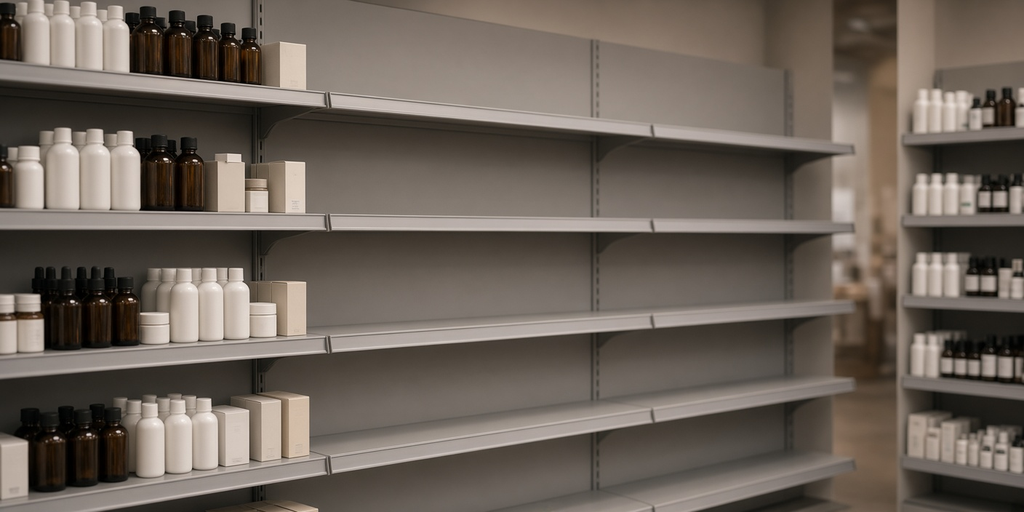
In July, by the trade press's count, roughly half the vendors at the CHAMPS trade show in Las Vegas were selling some version of a 7-hydroxymitragynine product. Six weeks later, at the August show, the official exhibitor roster listed 472 companies, of which fewer than twenty were identifiably kratom or kratom-alkaloid businesses by this publication's count. The largest product category in the smoke-shop channel had, on paper, nearly ceased to exist.
Shelf space is never left empty. This report is about what is moving into it — and about a change in the rules that the industry may not have noticed yet.
Disclosure. The Kratom Council is owned by NWB Distribution LP, which also operates the kratom retailer NuWave Botanicals; that affiliation appears on every page of this site. This report requires one more, because it reaches beyond kratom: the people who own and operate this publication also hold a commercial interest in the research-peptide trade, one of the categories discussed below. That is a direct interest in the subject of this report. This publication has therefore confined itself to the public record — federal enforcement documents, a published trade-show roster, and its own prior reporting — and it names no seller as having done anything wrong.
What Actually Left
Some of the disappearance is straightforward compliance. On August 26 a Drug Enforcement Administration order placed mitragynine pseudoindoxyl, MGM-15 and MGM-16 into Schedule I with no concentration threshold, and it took effect the morning the show opened. At least one seller has said so publicly: Real Botanicals, an exhibitor at the August show, posted a notice on its website headed “Where's Oxonol?” telling customers that with MGM-15 — which it had sold under the trade name Oxonol — now a Schedule I controlled substance, it can no longer sell the product. This publication reported that notice as the first documented instance of a vendor naming one of the three newly scheduled compounds in its own product line and announcing its withdrawal.
That is what an orderly exit looks like, and it deserves to be recorded as such. It is also, so far, the exception in the public record rather than a documented pattern. What the roster establishes is narrower: the category's booths are largely not at the show. It does not establish that the products are off every counter in the country, and this publication has not attempted to measure that.
The Botanical Answer
The first replacement is the one this publication's history of the loophole molecule predicted: another plant name.
Kanna — Sceletium tortuosum, a South African succulent with a long history of traditional use — and akuamma, a West African tree seed, are both appearing on shelves and, by this publication's direct observation at the August show, in the aisles. Neither is federally controlled. Kanna is generally sold within the dietary-supplement framework, which permits sale so long as no disease claims are made; akuamma occupies an even quieter space, marketed as a botanical with no FDA approval and little specific legislation addressing it. Iboga, a third name circulating in the same conversation, is different in kind: its principal alkaloid, ibogaine, has been Schedule I in the United States for decades.
The legal status of these plants is not, by itself, the story. Kanna and akuamma are real botanicals with their own traditions and their own scientific literature, and nothing in this report should be read as a claim that either is harmful or that either does anything in particular. The question this publication's history piece raised is narrower and it is about packaging, not botany: when a plant's name goes on the front of a foil blister pack and the ingredient statement reads “proprietary blend,” the name on the label stops being a reliable description of what is in the package. That has now happened, by industry accounts given to this publication, with kava and with “cat's claw.” Whether it happens with kanna is an open question that a buyer at a counter cannot answer.
The Answer That Is Not A Plant At All
The second replacement is more interesting, because it does not fit the twenty-year pattern at all.
Two exhibitors on the August roster identify themselves by name as peptide sellers: Peptide Club, at booth 8181, and Wholesale Peptide Supply, at booth 5239. Two is not a wave, and this publication is stating the number rather than an impression for that reason. Their appearance on a trade-show roster is a fact about the show and not a statement about their products; this publication makes no allegation about either company.
But the category's arrival at a smoke-shop trade show at all is the signal worth reading. Peptides — short chains of amino acids — are sold online in a channel that will be immediately familiar to anyone who lived through the herbal-incense era: product pages carrying the words “research use only” and “not intended for human consumption.” That is the same disclaimer, nearly word for word, that appeared on the Spice packets of 2006. It has been doing the same job for twenty years: creating distance between what a product is sold as and what everyone involved expects will happen to it.
The formats differ in a way that matters. The compounds in this category are frequently prepared as injectables, supplied as powder in a sealed vial to be reconstituted by the purchaser. A product sold in a smoke shop that is intended to be drawn into a syringe is a genuinely new proposition for that retail channel, and it carries a set of practical questions — sterility, reconstitution, dose measurement — that a pressed tablet does not. This publication is not offering a view on the safety of any product. It is observing that the failure modes of a vial are not the failure modes of a blister pack, and that the counter staff selling them are the same counter staff.
The Referee Changes
Here is the part the industry may not have priced in.
Every cycle in this history — synthetic cannabinoids, cathinones, the hemp-derivative wave, 7-OH and its analogs — was played against the Drug Enforcement Administration and the Controlled Substances Act. The rules of that game are well understood by everyone who has played it. A molecule gets scheduled; a modified molecule appears; the agency schedules that one; the cycle repeats, on a clock the trade has historically measured in months.
Peptides are, with narrow exceptions, not controlled substances. There is no scheduling order to wait out, because scheduling is not the mechanism. The relevant authority is the Food and Drug Administration, and the relevant law is the drug-approval architecture of the Food, Drug, and Cosmetic Act: a product marketed for a therapeutic effect without an approved application is an unapproved new drug, whatever the label says about research.
The FDA has been using it. On March 31, 2026, the agency issued warning letters to seven online peptide sellers, published together on April 7 — among them Gram Peptides, whose letter records that the agency reviewed the company's website between January and March 2026 and concluded it was offering unapproved drugs. The letters share a single legal argument, and it is the one that matters here: a “research use only” disclaimer does not control the analysis when the product pages themselves describe effects in people. According to the FDA's letter, the marketing contradicted the disclaimer.
That enforcement sits inside a broader escalation. In September 2025 the agency issued more than fifty warning letters over compounded GLP-1 products marketed with comparative claims to approved drugs. Reporting on the agency's 2026 output counts forty-three warning letters touching GLP-1s, peptides or related compounds so far this year, against fourteen in all of 2024.
The significance for this publication's readers is not the volume. It is that a federal regulator has now stated plainly, in writing, that the sentence which launched this entire twenty-year playbook — not intended for human consumption — does not do what the trade has always assumed it does. That holding does not depend on any molecule's structure, which means it cannot be engineered around by changing one. It is, in that narrow sense, the first move in this history that is not a game of whack-a-mole.
Not A Settled Question
It would be a distortion to present the peptide category as simply illicit. It is genuinely contested, and the federal record shows a regulator working through it rather than shutting a door.
BPC-157, among the most widely discussed of these compounds, illustrates the point. On April 15, 2026, the FDA removed it and eleven other peptides from the compounding category that had effectively barred their use, and referred them for advisory review. On July 23 and 24, the agency's Pharmacy Compounding Advisory Committee voted eight to six — a two-vote margin — to recommend that BPC-157 be moved into the category permitting compounding, tied to a specific proposed indication. A near-evenly divided expert committee is not the profile of a settled question, and readers should hold the category's status loosely for that reason.
The distinction that has organized federal policy on kratom applies here as well, and it is worth stating: the setting in which a compound is used is doing much of the work. A peptide prepared by a licensed pharmacy for a named patient and the same molecule shipped from a website under a research disclaimer are not the same regulatory object, whatever the chemistry.
What This Means For The Leaf
Kratom's stake in this is not obvious, so it is worth making explicit.
In every prior cycle, the damage attached to the borrowed name. Nine deaths in Sweden were recorded against a product called Krypton that was sold as kratom and was found to contain a synthetic opioid metabolite. Products sold as exceptionally strong kava, by industry accounts, carried a scheduled kratom analog. The plant on the label absorbs the headline; the proprietary blend does not.
If the channel's next category is peptides, kratom is not the carrier this time. But it is the same channel, the same retailers, and in many cases the same counter. Federal policy has so far drawn its line between the leaf and the laboratory — the FDA has stated the pending 7-OH proposal is “not intended to apply to natural kratom leaf containing only naturally occurring trace levels of 7-OH.” Whether that line survives contact with a channel that keeps producing new categories is the question in front of the industry, and it is the argument supporters of state Kratom Consumer Protection Acts have been making: regulate the leaf, prosecute the adulterators. Nine states have instead banned the plant outright. Both approaches are running now, and this cycle will test them.
Meanwhile the immediate federal business is unfinished. The DEA's proposed order on 7-OH above a 0.050 percent threshold has still not issued as of this publication's last verified check of the Federal Register, more than three weeks after the statutory minimum elapsed on August 5. The related HHS comment window closes September 10.
The Next Question
Twenty years of this pattern have taught the trade to watch one agency and one list. The evidence of the past six months suggests that is the wrong place to be looking. The category taking the shelf space is not regulated by scheduling, the disclaimer that shielded four previous waves has been directly rejected, and the enforcement tempo has roughly tripled year over year.
There is one more layer, and it is the subject of this publication's next report. Federal agencies are not the only regulators moving on this category: state attorneys general have been reaching sellers through consumer-protection and unfair-trade-practice law, which does not require a scheduling order or a drug application, and at least one state has already written peptide-specific disclosure requirements into law. The federal question is which agency has jurisdiction. The state question is whether it matters.
Sources
- U.S. Food and Drug Administration — warning letter, Gram Peptides, MARCS-CMS 721806 (March 31, 2026)
- Health Law Alliance — "FDA Targets GLP-1 and Peptide Compounding, Advertising and 'Research Use Only' Labeling"
- U.S. Food and Drug Administration — Pharmacy Compounding Advisory Committee meeting, July 23–24, 2026
- U.S. Food and Drug Administration — PCAC briefing document (July 2026 meeting)
- Federal Register — temporary scheduling order, mitragynine pseudoindoxyl, MGM-15 and MGM-16, Docket No. DEA-1644 (published and effective August 26, 2026)
- Federal Register — DEA notice of intent on 7-hydroxymitragynine above a specified threshold, Docket No. DEA-1570 (July 6, 2026)
- CHAMPS Trade Shows — official interactive exhibitor floor plan and exhibitor list, Las Vegas Summer 2026
- Real Botanicals — retailer notice, "Where's Oxonol" (accessed August 30, 2026)
- SupplySide Supplement Journal — "7-OH: Kratom alkaloid sparks debate at CHAMPS trade show" (July 2026)
- The Kratom Council — "Badges Out: DEA Agents Walked The Floor At CHAMPS As The Analog Ban Took Effect"
- The Kratom Council — "Before 7-OH, There Was Spice: A History Of The Loophole Molecule"
- The Kratom Council — "The Council Answers: What The August 26 Scheduling Order Actually Covers — And What It Does Not"
- Kronstrand R., Roman M., Thelander G., Eriksson A. — "Unintentional Fatal Intoxications with Mitragynine and O-Desmethyltramadol from the Herbal Blend Krypton," Journal of Analytical Toxicology 35(4) (2011)
Get new reporting by email
Federal and state kratom policy, enforcement actions and court decisions — sent when we publish, and nothing else.
The Kratom Council does not sell kratom. This list is used only to send our own articles — never product marketing, and it is never shared with or merged into any retailer’s mailing list. Unsubscribe any time.