
Industry
Badges Out: DEA Agents Walked The Floor At CHAMPS As The Analog Ban Took Effect
On Wednesday morning, August 26, a Drug Enforcement Administration order placing three kratom-derived and kratom-adjacent compounds into Schedule I published in the Federal Register and took effect on publication. That same day, CHAMPS — the Contemporary Hemp and Arts Merchandise Professionals Show, the smoke-shop industry's largest trade event — opened its summer run at the Las Vegas Convention Center, scheduled for August 26 through 28.
The two dates were not a secret to anyone holding an exhibitor badge. By the time the doors opened, the products the order reaches — mitragynine pseudoindoxyl, MGM-15 and MGM-16, the compounds sold over the past year as successors to concentrated 7-hydroxymitragynine — were federally illegal to distribute, with no concentration threshold and no grace period.
What Was Visible On The Floor
This publication attended the show's final day and spoke with exhibitors and attendees who were present across its three days. One distinction governs everything in this section: this publication did not itself see federal agents on the floor during its visit. The agent presence described below is reported entirely from the accounts of multiple people who said they witnessed it — several of them speaking to this publication independently of one another — and it is presented as witness account, not as this publication's own observation or as any official record of agency activity.
Those witnesses described federal agents present on the exhibit floor openly — not undercover: personnel with badges displayed and jackets marked with large agency lettering, moving through the aisles. Their attention, by every account given to this publication, was directed at whether newly scheduled synthetic extract products were being displayed or offered.
Witnesses also described booths that stood fully built but unstaffed — banners up, product displays assembled, no employees present — and, at the booth of one prominent extract brand, a period during which the only people standing at it were four federal agents, one positioned at each corner. This publication is deliberately not naming that exhibitor: an empty booth and an agency presence are observations, not findings, and they establish nothing about any company's conduct.
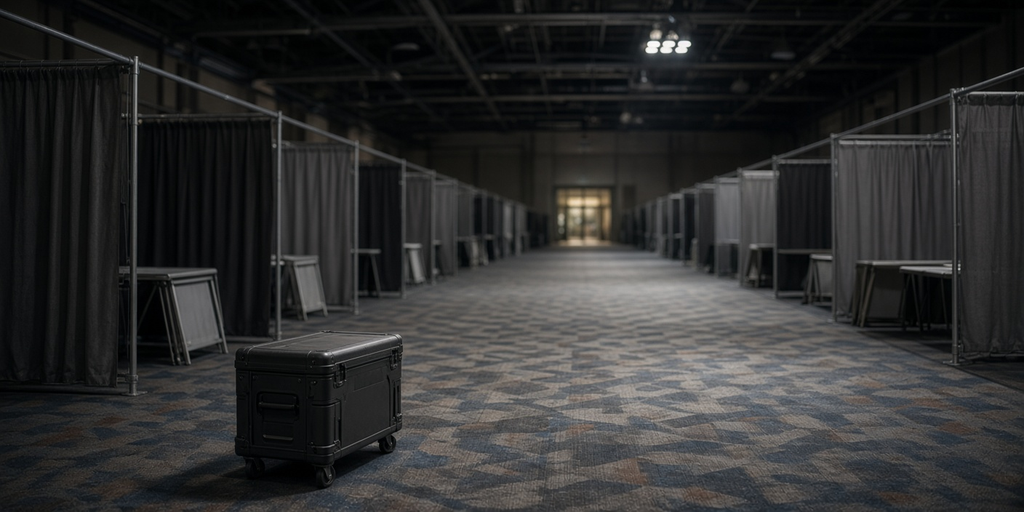
Two things this publication did observe directly on the final day: a show running at a fraction of its former scale, and — notably — products presented as a next generation of novel alkaloid compounds, on open display days after the last generation entered Schedule I.
What This Does And Does Not Establish
The restraint in the previous sentence applies to the whole scene, and it runs in both directions.
The Drug Enforcement Administration had made no public statement about activity at the show that this publication could locate by publication time. No seizures, citations or arrests at the venue have been confirmed to this publication, and the agent presence itself rests on witness accounts rather than this publication's own eyes. A visible agent presence during the first days of a new scheduling order is consistent with enforcement, with monitoring, and with deterrence, and nothing in those accounts distinguishes among those. The timing — an order effective the morning a major industry show opened — is documented by the Federal Register's own dates; whether it was chosen for that reason is not something the public record answers.
What the scene does establish is narrower and still significant: the compounds marketed for the past year as legal successors to 7-OH were treated as scheduled substances, in public, at the industry's biggest gathering, within hours of the order taking effect. Exhibitors appear to have understood this — the empty booths say as much — and the agency appears to have considered the show worth its presence.
That understanding is now visible in writing. Real Botanicals — booth 6145 on the show's official exhibitor list — has posted a notice on its website headed “Where's Oxonol?”, telling customers that with the DEA's classification of MGM-15 — a compound it sold under the trade name Oxonol — as a Schedule I controlled substance, it can no longer sell the product. It is the first instance this publication has documented of a vendor publicly identifying one of the three newly scheduled compounds in its own product line and announcing its removal from sale.
A Different Show Than A Year Ago
The backdrop is an industry segment that expanded extremely quickly and is now contracting under regulatory pressure. When CHAMPS last convened in Las Vegas in July, the trade publication SupplySide Supplement Journal reported that roughly half of the show's approximately 400 vendors were selling some version of a 7-OH product, quoting an industry representative who said that where only a few booths had displayed the products in February, by summer “everybody had it.” The event itself has contracted sharply: by this publication's direct observation, this summer's show ran at roughly a quarter of the scale it has commanded in recent years, when it filled far more of the convention center's space. The official interactive floor plan for the August show, reviewed by this publication, lays the entire exhibition out within a single hall of the convention center.
The show's official exhibitor roster completes the picture. The August list, reviewed by this publication, runs to roughly 470 exhibiting companies — glass artists, vape brands, wholesale distributors, payment processors — of which fewer than twenty are identifiably kratom or kratom-alkaloid businesses, by this publication's count. A month after a floor where, by the trade press's account, half the vendors carried 7-OH, the segment had all but vanished from the official roster. What appears instead, in ones and twos, are peptide, mushroom and kava names.
Between that July show and this one: the DEA's July 6 notices of intent on 7-OH and its analogs, Food and Drug Administration warning letters, state attorney general actions in Texas, Missouri and Florida, and now a final order on the three analog compounds — effective, per the Federal Register, from August 26, 2026 until at least August 26, 2028.
And yet the floor was not out of the novel-compound business. Products presented as a next generation of alkaloid formulations were on open display at this show, days after the last generation entered Schedule I. The industry has run that cycle before, more than once; this publication traces its history separately.
The Order Behind The Agents
The order that took effect as the show opened is the one this publication reported on August 26: Docket DEA-1644, placing mitragynine pseudoindoxyl, MGM-15 and MGM-16 into Schedule I on a temporary basis, with no threshold of the kind proposed for 7-OH itself. The separate proposed order on 7-hydroxymitragynine above a 0.050 percent threshold — the one the industry has been waiting on since the thirty-day statutory minimum elapsed August 5 — had not issued as of this publication's last verified check of the Federal Register. Natural kratom leaf is not the subject of either action; the FDA has stated the 7-OH proposal is “not intended to apply to natural kratom leaf containing only naturally occurring trace levels of 7-OH.”
The show closed Friday evening. The order it opened under runs for two years.
And what comes next may already be on the roster. CHAMPS has long been where the smoke-shop industry meets its next product — a pattern this publication's companion history traces through the herbal-incense, bath-salt, hemp-derivative and 7-OH eras, each of which ran across this floor before it ran into a scheduling order. Read the August exhibitor list the same way and one line stands out: alongside the kanna and akuamma now moving toward the front of the shelf, peptide sellers — a category of laboratory-made compounds marketed as research materials, many of them prepared as injectables — have taken booths at a show built for pipes, papers and vapes. Whether that category becomes this industry's next chapter, what is actually in those vials, and what happens when a retail channel that has already run this cycle four times picks up a product designed for a syringe — that is the question this publication's next report takes up.
Sources
- Federal Register — temporary scheduling order, mitragynine pseudoindoxyl, MGM-15 and MGM-16, Docket No. DEA-1644 (published and effective August 26, 2026)
- U.S. Department of Justice — press release, "Justice Department Announces Emergency Scheduling of Three Potent Opioid Compounds"
- The Kratom Council — "DEA Schedules Three 7-OH Analogs. The 7-OH Threshold Order Itself Still Has Not Issued." (August 26, 2026)
- The Kratom Council — "The Federal Comment Window On 7-OH Has Closed. The Order Can Issue Any Time After August 5." (August 3, 2026)
- CHAMPS Trade Shows — Las Vegas, August 26–28, 2026, Las Vegas Convention Center
- CHAMPS Trade Shows — official interactive exhibitor floor plan and exhibitor list, Las Vegas Summer 2026 (Las Vegas Convention Center, August 26–28, 2026)
- SupplySide Supplement Journal — "7-OH: Kratom alkaloid sparks debate at CHAMPS trade show" (July 2026)
- Real Botanicals — retailer notice, "Where's Oxonol", stating that MGM-15 (sold as Oxonol) is now a Schedule I controlled substance and can no longer be sold (accessed August 30, 2026)
- Federal Register — DEA notice of intent on 7-hydroxymitragynine above a specified threshold, Docket No. DEA-1570 (July 6, 2026)
- Federal Register — DEA notice of intent, temporary placement of mitragynine pseudoindoxyl, MGM-15 and MGM-16 in Schedule I (July 6, 2026)
Get new reporting by email
Federal and state kratom policy, enforcement actions and court decisions — sent when we publish, and nothing else.
The Kratom Council does not sell kratom. This list is used only to send our own articles — never product marketing, and it is never shared with or merged into any retailer’s mailing list. Unsubscribe any time.