
Industry
Before 7-OH, There Was Spice: A History Of The Loophole Molecule
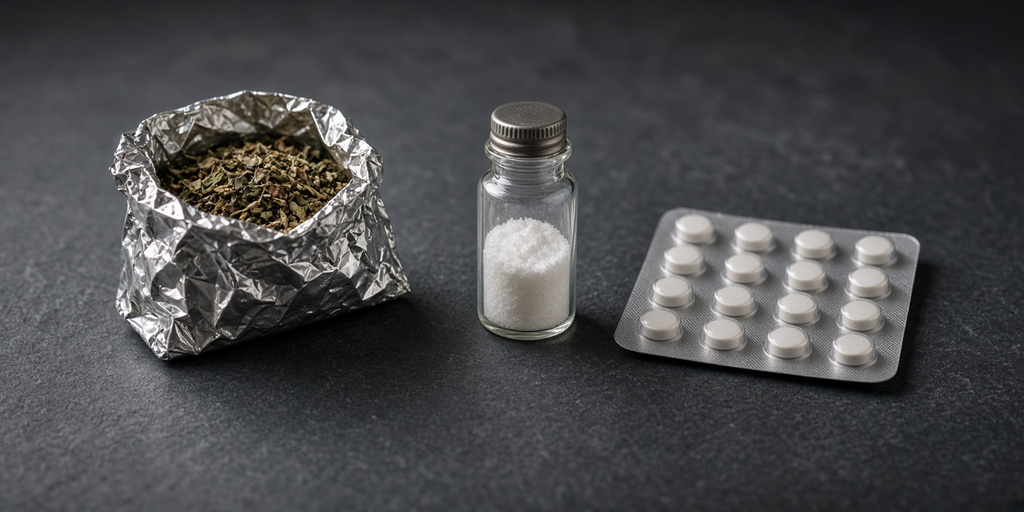
Pick up a foil blister pack of pressed tablets from the counter of a gas station this week and look for the name of a plant on it. Increasingly, there isn't one. That absence is not an oversight. It is the end point of a twenty-year experiment in American drug retail — one that began with a jar of “herbal incense,” passed through a nationwide federal takedown, reinvented itself through a farm bill, attached itself to a Southeast Asian leaf, and arrived, last week, at a trade-show floor in Las Vegas where witnesses described federal agents walking the aisles while a next generation of novel compounds sat on open display. This is the history of the playbook: a legal botanical on the label, a laboratory compound doing the work, and a fresh molecule ready for the day regulators catch the current one.
The Oldest Technology Is Plant Chemistry
Combining or treating plants to change what they do to the mind is among the oldest documented human technologies. Indigenous peoples of the South American rainforest developed ayahuasca as a deliberate two-plant system: a vine whose β-carboline alkaloids inhibit the body's monoamine oxidase enzymes, brewed with admixture leaves whose active compound is not orally active on its own — only the combination produces the effect those traditions sought. Andean coca chewing pairs the leaf with an alkaline ash or lime that changes how the leaf's alkaloids release. Betel quid, across Asia and the Pacific, combines areca nut with slaked lime for the same chemical reason. Aboriginal Australians mixed pituri — nicotine-bearing Duboisia leaves — with alkaline plant ash. None of it was accident; all of it was applied chemistry, worked out empirically, millennia before the word existed.
What none of those traditions had was a scheduling system to route around. That is the modern contribution.
The Compounds Came Off A Chemist's Shelf
The molecules behind the “herbal incense” wave were not invented by traffickers. They were research tools, published in the open literature. The JWH series — the initials are the chemist's — came from the Clemson University laboratory of organic chemist John W. Huffman, whose group synthesized more than 470 cannabimimetic compounds as probes for studying cannabinoid receptors; JWH-018, the one that would anchor the street phenomenon, was made there in the mid-1990s and described in the peer-reviewed literature. CP-47,497 came out of pharmaceutical analgesia research years earlier. Publication is what made them available: the syntheses were in the journals, for anyone who cared to read them.
The Herb On The Label Was Never The Product
Products branded “Spice” were selling in European shops and online by at least 2006 — anecdotal reports push it to 2004 — marketed, in the words of the European Union drugs agency's 2009 study, as an “exotic incense blend which releases a rich aroma,” labeled “not for human consumption.” The packages listed botanicals. When laboratories analyzed the products, the listed herbs were not the story: the agency's monitoring identified the aminoalkylindole JWH-018 and the C8 homologue of CP-47,497 — cannabicyclohexanol — as actives in the blends. In the American products that followed under names like K2, industry veterans recall the same architecture: labels naming mild or essentially inert carrier herbs — damiana and marshmallow leaf are the two most commonly remembered — while the sprayed-on compound did what buyers were paying for.
The commercial pitch, as marketed at the time, was a triple loophole: not scheduled, so nominally legal; not cannabis, so invisible to a cannabis drug test; “not for human consumption,” so liability stayed at arm's length. Cannabis itself was — and federally remains — a Schedule I plant. The synthetics were sold as everything the scheduled plant could not legally be, in places the scheduled plant could never be sold: smoke shops first, then gas stations and convenience stores, then the open internet.
How It Spread: Accounts From Inside The Trade
What follows is industry memory — accounts given to this publication by people who were in the trade at the time, presented as recollection rather than established record.
One story that circulated widely, never to this publication's knowledge confirmed in any public account, tells of a British chemist traveling smoke shop to smoke shop, handing out samples of an “herbal” blend that would mimic cannabis without tripping a test, leaving a phone number for reorders. Whatever the truth of that figure, the sampling model is exactly how people in the trade remember the products arriving. Veterans of the Utah scene in the late 2000s describe buying compounds directly from traveling suppliers — naming CP-47,497 and its homologues, and aminoalkylindoles such as JWH-018 and JWH-073 — and blending domestically; supply, by the same accounts, came from overseas chemical manufacturers and from labs inside the United States alike.
For the shops it was transformative. A smoke shop of that era sold paraphernalia — papers, glass, apparel. A legal consumable at the register was a new category, and it changed the economics of the business. It remade the trade shows too: veterans recall floors, CHAMPS among them, where by their estimate eight or nine of every ten booths carried some form of the synthetic wave. CHAMPS has always been where counterculture retail finds its next product. For several years, the next product was this.
Ninety Arrests In A Hundred And Nine Cities
The federal response came in stages, and each stage teaches something about the next twenty years. In March 2011 the DEA emergency-scheduled the five core Spice compounds. In October 2011 it did the same for three synthetic cathinones — mephedrone, MDPV and methylone, the actives of the “bath salts” sold beside the incense packets. The cathinone products had produced their own emergency: poison-center calls involving MDPV alone rose from 302 in 2010 to more than 5,600 in the first eleven months of 2011, and emergency-department case series documented severe agitation and psychiatric effects in a large share of patients. Sellers who kept the newly scheduled versions on their shelves were now selling Schedule I substances, and arrests followed.
Then came the hammer. On July 26, 2012, the DEA and its partners executed Operation Log Jam — the first nationwide, multi-agency enforcement action against the synthetic-drug industry — across 109 cities: about ninety arrests, more than $36 million in cash, roughly 4.8 million packets of synthetic cannabinoids seized along with material to produce 13.6 million more, plus 167,000 packets of cathinone products. Congress had acted three weeks earlier, permanently scheduling the core compounds through the Synthetic Drug Abuse Prevention Act of 2012.
And yet the category did not die, because the chemistry could always outrun the list. A federal analogue statute had existed since 1986, but it works case by case, substance by substance, prosecution by prosecution — and each newly tweaked molecule bought its sellers a fresh window while authorities found it, tested it, and wrote it down. People in the trade at the time put that window at six to nine months per compound. The tweaks themselves were leaps in the dark: the research literature on later-generation synthetic cannabinoids documents compounds that grew more potent and less predictable with each wave, a cycle that regulators and researchers alike have compared to a game of whack-a-mole. Ban one; three more surface. States wrote their own bans around the federal gaps, and the market simply routed around both.
The Hemp Pivot
The next window was opened not by a chemist but by Congress. The 2018 Farm Bill removed hemp from the Controlled Substances Act and defined it by one number: no more than 0.3 percent delta-9 THC. The phrase “delta-9” left every other THC isomer unaddressed, and manufacturers moved immediately — converting legal, abundant CBD by acid-catalyzed isomerization into delta-8 THC and a growing alphabet of relatives, sold in the same gas stations and convenience stores that had carried the incense packets a decade earlier. CBD, the legal botanical extract of the moment, had become the new carrier — the label on the front, while conversion chemistry did the work. The DEA's 2020 interim rule on synthetically derived tetrahydrocannabinols, state bans, and years of litigation followed; Congress finally closed the definition in late 2025 with a total-THC standard that takes full effect this November. Seven years, one word, an industry.
Then The Playbook Found A Leaf
Kratom's American story runs on a different track, and the difference matters to everything that follows. Mitragyna speciosa is a tree in the coffee family, used traditionally in Southeast Asia for generations. Its American rise coincided with the opioid crisis: in a Johns Hopkins Medicine survey of more than 2,600 users published in 2020, 91 percent reported using kratom for pain and 41 percent to address opioid withdrawal — self-reports, reported here as what users told researchers. The plant drew serious scientific attention as well. The National Institute on Drug Abuse has funded kratom research at the University of Florida's College of Pharmacy — including grants of $3.5 million and $3.4 million — where medicinal chemist Christopher McCurdy has studied the plant for more than twenty years; Johns Hopkins researchers have published on its use patterns and abuse potential.
Southeast Asia had already seen what happens when the leaf is combined with pharmaceuticals: in southern Thailand, a cocktail of kratom tea brewed with codeine cough syrup and cola — known in the literature as 4x100 — became a banned drug of abuse in its own right. The pattern to notice: the trouble followed the mixing, and enforcement followed the trouble.
Krypton: The First Adulteration Warning
The clearest early warning of what adulteration would do to kratom's name came from Sweden. Between 2009 and 2010, nine people died after using a product sold as “Krypton” — marketed as kratom. Forensic analysis, published in the Journal of Analytical Toxicology in 2011 by Kronstrand and colleagues, found the powder had been spiked with O-desmethyltramadol, a potent synthetic opioid metabolite, and concluded the addition of that compound was what made the product lethal. The label said a plant; the chemistry said otherwise.
Those nine deaths did not stay in Sweden. When the FDA announced in 2018 that it had counted 44 deaths “involving” kratom, the Swedish Krypton cases were among them, and most of the remainder involved multiple other substances. The headline number attached to the plant; the case files pointed, again and again, at what had been added to it or taken alongside it. This publication has examined that attribution problem — what a toxicology report can and cannot establish — in a separate report.
From Leaf To Tablet
Which brings the story to 7-hydroxymitragynine. In the living plant and fresh leaf, 7-OH is scarce; published analyses put it at 0.011 to 0.039 percent of leaf by dry weight — below the 0.050 percent line the DEA's pending proposal draws for that reason. Some of what exists in commercial leaf arises after harvest: oxidation as leaves are processed and dried converts a small fraction of mitragynine. Indonesian processors have long run a deliberate version of this, and this publication has documented it first-hand at origin: freshly harvested leaves packed tight into large plastic sacks and left to sweat in the heat, condensation fogging the plastic as the green darkens, before the softened leaf is spread on racks and tarps to dry into something with a visibly different color, smell and character — the fermented style sold as Bentuangie. Traditional processing, in other words, nudges the chemistry by fractions of a percent.
The products that provoked the federal docket were something else entirely: tablets and extracts containing concentrated or synthesized 7-OH at levels no leaf produces — a concentration step that, by industry accounts given to this publication, largely happened after material reached the United States. And the format mattered as much as the molecule. The pressed tablet in the blister pack became the product's identity — recognizable at any counter, needing no plant name at all — and it stopped looking like a botanical product at all. The tablets arrived in bright colors and named flavors, sold as chewables with the color of the tablet keyed to the flavor printed on the box, alongside gummies, drink mixes and canned beverages. Retail listings for one widely distributed line run through white grape, blue lemon, melon slush, blueberry limeade, rainbow sherbet and rocket pop — the last two named after ice-cream-truck novelties — and offer an unflavored version as a separate option, described as the classic alkaloid taste. Flavoring, in other words, is the default; its absence is the variant. The same listings advertise strengths from thirty milligrams a tablet to more than a hundred, under headings like “extra strength,” “max potency” and “advanced users only.” A product is being sold as confectionery on the front of the box and as a controlled dose on the back of it. Federal health officials have described that presentation bluntly, calling the products “marketed for children” — “they're gummy bears, they're bright colors, they're candy flavored” — with tablets no larger than a SweeTart. The Food and Drug Administration has stated that 7-OH cannot lawfully be added to conventional foods or dietary supplements at all, because the information needed to establish its safety does not exist. By industry accounts, the retail architecture matured with it: counter sales in smoke shops, gas stations and convenience stores introducing the product, packaging steering repeat buyers to e-commerce for discreet shipping — a channel structure that is harder for any enforcement agency to see whole.
The Label Moves Again
As 7-OH headed toward scheduling, the successor compounds arrived on cue — mitragynine pseudoindoxyl first among them, initially marketed as just another kratom alkaloid — and the carrier labels began to move to whatever legal botanical was nearest to hand. Industry accounts given to this publication describe kava products spiked with pseudoindoxyl and sold as exceptionally strong kava, and blister-pack products marketed under “cat's claw” — a vine that happens to be a botanical relative of kratom — with the operative ingredient listed, if at all, as a proprietary blend. This publication has not independently verified the contents of any specific product, and names none; the pattern it describes is the same one the EU agency documented in 2009, with new nouns.
The human cost of that pattern lands on the borrowed name. When someone is harmed by a spiked product, the family says — accurately, as far as they know — that their loved one was “only taking kratom,” or only taking kava. The plant absorbs the headline; the proprietary blend walks away. It happened with Krypton in 2011, and the same misattribution mechanics are documented in this publication's separate reporting on 7-OH-era toxicology.
On August 26, the DEA placed pseudoindoxyl, MGM-15 and MGM-16 — compounds with no meaningful presence in the natural leaf — into Schedule I with no threshold, while the 7-OH order itself waits, its threshold calibrated to leave naturally occurring leaf levels untouched, its comment window open until September 10. The line federal regulators have drawn, so far, runs between the leaf and the laboratory: the FDA has stated the 7-OH proposal is “not intended to apply to natural kratom leaf containing only naturally occurring trace levels of 7-OH.” Whether that line holds is the policy question of the next year. Supporters of state Kratom Consumer Protection Acts argue the alternative to blanket plant bans is exactly this kind of separation — regulate the leaf, prosecute the adulterators; nine states have instead banned the plant outright. Both approaches are now running, in parallel, as live experiments.
Where Did The Booths Go
Which returns the story to Las Vegas, where it is still happening. At last week's CHAMPS — a show witnesses described to this publication as swept by openly badged federal agents, with some extract-brand booths standing built and empty — the aisles were roughly a quarter of the show's former size. The 7-OH, pseudoindoxyl and “botanical-label” booths that defined the last two years were largely gone. What this publication observed in their place: products presented as a next generation of novel alkaloids, and a fresh set of plant names moving toward the front of the pack — kanna, akuamma, and others — botanicals with their own traditions and their own chemistry, appearing beside the words that should by now put any reader of this history on alert: proprietary blend. One name circulating in that conversation, iboga, carries an alkaloid that has been Schedule I in the United States for decades — a reminder that not every borrowed plant even offers a loophole to exploit.
Twenty years of this pattern permit one confident prediction and force one open question. The prediction: the pack will keep changing what is inside it faster than the law changes what is written down. The question is the one the DEA's presence on that floor was already asking: which plant's name gets borrowed next — and what will actually be in the blister pack that carries it That is the subject of this publication's next report.
Sources
- EMCDDA (now EUDA) — thematic paper, "Understanding the 'Spice' phenomenon" (2009)
- Federal Register — DEA, temporary placement of five synthetic cannabinoids into Schedule I (March 1, 2011)
- Federal Register — DEA, temporary placement of three synthetic cathinones into Schedule I (October 21, 2011)
- DEA press release — "Chemicals Used In 'Bath Salts' Now Under Federal Control And Regulation" (October 21, 2011)
- CNN — "Federal agents arrest 'designer drug' makers in nationwide raids" (Operation Log Jam, July 26, 2012)
- DEA press release — Operation Log Jam sentencings (April 7, 2014)
- Federal Register — DEA, permanent placement of five synthetic cannabinoids into Schedule I (2012)
- NPR — "How The Wave Of Synthetic Cannabinoids Got Started" (January 4, 2019)
- Chemical & Engineering News — profile, "John W. Huffman" (2010)
- "The K2/Spice Phenomenon: emergence, identification, legislation and metabolic characterization of synthetic cannabinoids in herbal incense products" (journal review, PMC4100246)
- "The Toxicology of Bath Salts: A Review of Synthetic Cathinones" (journal review, PMC3550219)
- Congressional Research Service — "The 2018 Farm Bill's Hemp Definition and Legal Challenges to State Laws Restricting Certain THC Products" (R48637)
- Kronstrand R., Roman M., Thelander G., Eriksson A. — "Unintentional Fatal Intoxications with Mitragynine and O-Desmethyltramadol from the Herbal Blend Krypton," Journal of Analytical Toxicology 35(4) (2011)
- Johns Hopkins Medicine — news release on the Garcia-Romeu kratom user survey (February 2020)
- University of Florida College of Pharmacy — "$3.5 million NIDA grant to bolster kratom research" (December 2018); companion $3.4 million grant (May 2019)
- The Kratom Council — "DEA Schedules Three 7-OH Analogs. The 7-OH Threshold Order Itself Still Has Not Issued." (August 26, 2026)
- The Kratom Council — "The Federal Comment Window On 7-OH Has Closed. The Order Can Issue Any Time After August 5." (August 3, 2026)
- The Kratom Council — "Badges Out: DEA Agents Walked The Floor At CHAMPS As The Analog Ban Took Effect" (companion field report)
- The Kratom Council — "Why A Death Caused By 7-OH Can End Up Recorded As Mitragynine"
Get new reporting by email
Federal and state kratom policy, enforcement actions and court decisions — sent when we publish, and nothing else.
The Kratom Council does not sell kratom. This list is used only to send our own articles — never product marketing, and it is never shared with or merged into any retailer’s mailing list. Unsubscribe any time.