
Regulation
The Caffeine Test: Why Federal Regulators Scheduled the Molecules, Not the Kratom Leaf
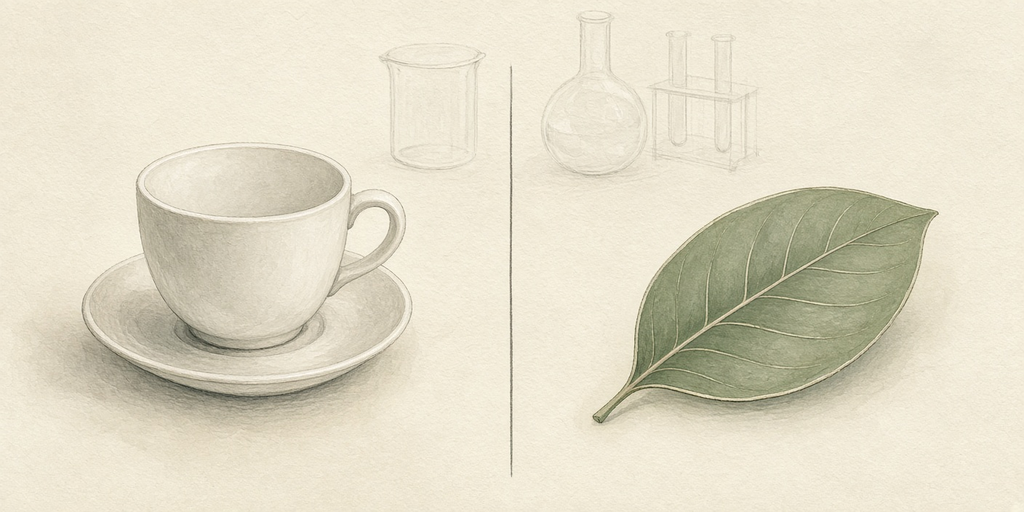
Regulators already know how to separate a plant from a concentrated chemical made from it. They did it with caffeine. The August 26 scheduling order shows they can do it with kratom too.
One molecule, two rules
Caffeine is the same molecule in a brewed cup of coffee and in a bag of pure powder. Federal policy does not treat those two products the same way.
In 2018 the Food and Drug Administration issued guidance stating that dietary supplements made of pure or highly concentrated caffeine are unlawful when sold in bulk directly to consumers. The agency's reasoning was about form and measurement. It noted that a single teaspoon of pure caffeine powder holds roughly the caffeine of 28 cups of coffee, and that the gap between an ordinary amount and a toxic one is very hard to measure in a kitchen.
The FDA did not ban coffee. It did not ban tea or labeled beverages. Same molecule, different product, different rule.
Now take a thought experiment. Suppose a chemist used caffeine as a starting scaffold and built an entirely new compound from it, one that laboratory testing showed to be vastly more potent than anything in a coffee bean. No serious regulator would answer that by padlocking every coffee shop in the country. The new compound would be controlled by name, and the bean would be left alone.
That scenario is hypothetical. It is offered only to illustrate regulatory structure. It is not a comparison between kratom and coffee in any other respect. This is despite the fact that kratom (Mitragyna speciosa) actually is in the coffee family, Rubiaceae.
What happened with kratom
The leaf of Mitragyna speciosa contains mitragynine as its principal alkaloid. A second alkaloid, 7-hydroxymitragynine, or 7-OH, is present only in trace amounts. Those are facts about the plant.
Many products sold under the kratom name in recent years look nothing like that profile. In its scheduling order, the Drug Enforcement Administration described a market shift away from natural leaf products and toward flavored, standardized, high-potency semisynthetic substances. Three of them are now in Schedule I.
- Mitragynine pseudoindoxyl (MGPI). DEA describes it as a chemical rearrangement product of 7-OH. The order states that published scientific literature has not established it as a naturally occurring kratom alkaloid.
- MGM-15. Also called dihydro-7-hydroxymitragynine, a derivative of 7-OH.
- MGM-16. A fluorinated derivative in the same series. The Justice Department said it had not been confirmed in consumer products but could emerge as a substitute.
The potency figures explain why this is not a branding dispute. DEA cited preclinical data showing MGPI at about 100 times the potency of mitragynine, and MGM-15 and MGM-16 at roughly 50 to 240 times the potency of morphine in animal models. These are laboratory and animal figures, not human data. They are also the figures the federal government relied on.
What the order did, and what it did not do
The temporary order was published in the Federal Register and took effect on August 26, 2026. It runs through August 26, 2028, with a possible one-year extension. It applies the full set of Schedule I controls to MGPI, MGM-15 and MGM-16, and retail consumer sales of products containing them must stop.
It does not schedule kratom leaf. It does not schedule mitragynine. 7-OH itself is the subject of a separate DEA notice, which proposes a threshold of 0.05 percent 7-OH for plant material, and 0.05 percent or 1 milligram per article for extracts, concentrates, processed edibles and pressed pills. DEA has said that action is not aimed at botanical products containing naturally occurring 7-OH below that threshold. The 7-OH order was still pending when the three-compound order took effect.
That is the coffee-shop instinct, written into federal policy. The government named the engineered molecules. It proposed a numerical line meant to separate trace, naturally occurring 7-OH from fortified products. Our earlier report walks through what the August 26 order actually covers and what it does not.
Why a blanket ban repeats the mistake
Some states and cities have chosen to restrict every form of kratom, as Massachusetts did this summer. The federal record now gives lawmakers a more precise option.
Banning every kratom product because chemists rearranged, hydrogenated and fluorinated one of its alkaloids is the coffee-shop closure from the thought experiment. It treats the source material as if it were the engineered product. It also leaves the actual problem, novel compounds sold under a familiar name, to be solved by the same blunt instrument the next time a new derivative appears. The Council has traced that cycle before in our history of the loophole molecule.
None of this means kratom leaf is free of risk, and this article does not claim it is. Kratom is not approved by the FDA for any use. Contamination, adulteration and mislabeling are real problems in this market. Sensible regulation can address every one of them and still tell the products apart.
The test is already on the certificate
The distinction regulators need is measurable. A certificate of analysis from an independent lab either shows a leaf profile, with mitragynine dominant and 7-OH at trace levels, or it shows something else: elevated 7-OH, MGPI, MGM-15 or MGM-16.
A workable framework follows from that. Require independent third-party testing for every batch. Adopt the federal 7-OH threshold by reference so state and federal lines match. Name the synthetic derivatives explicitly. Set a clear purchase age of 18 years of age or older, or 21+ where required by applicable state law.
The first profile is the plant. The second is a new chemical carrying the plant's name. Federal regulators have already shown they can tell the difference. They have done it with caffeine for years.
Sources
- Federal Register, Temporary Placement of Mitragynine Pseudoindoxyl, MGM-15, and MGM-16 in Schedule I (August 26, 2026)
- Federal Register, Temporary Placement of 7-Hydroxymitragynine Above a Specified Threshold in Schedule I (July 6, 2026)
- DEA press release on intent to temporarily schedule 7-OH and related substances (July 1, 2026)
- FDA, Guidance for Industry: Highly Concentrated Caffeine in Dietary Supplements (2018)
This article is for informational purposes only and is not legal or medical advice. Federal scheduling status can change on the date of Federal Register publication. See our editorial policy.
Get new reporting by email
Federal and state kratom policy, enforcement actions and court decisions — sent when we publish, and nothing else.
The Kratom Council does not sell kratom. This list is used only to send our own articles — never product marketing, and it is never shared with or merged into any retailer’s mailing list. Unsubscribe any time.