
Regulation
For Fifteen Weeks The Trade Watched One Number. On October 9 The Federal Government Replaced It With A Ratio, And A Ratio Does Not Treat Every Product The Same.
Since July 6 there has been a single figure at the centre of this industry's planning. The Drug Enforcement Administration's notice of intent proposed to place 7-hydroxymitragynine in Schedule I above a specified threshold, and the threshold was an amount: 0.050 per cent by weight, or more than one milligram in an article. Every state bill, every compliance memo and every certificate of analysis written since has been measured against that number.
On October 8 the Department of Health and Human Services sent the Drug Enforcement Administration a new recommendation, announced publicly the following day, and the Department of Justice said the agency would issue two fresh notices of intent to carry it. One reissues the proposal on MGM-15 and MGM-16 without change. The other replaces the 7-OH proposal with something structurally different.
It is no longer only an amount. It is an amount and a ratio.
What The New Test Is
As reported, the recommendation would reach 7-OH and mitragynine pseudoindoxyl, either substance alone or the two combined, on two independent tests.
The first is a concentration: more than one milligram per gram in a solid product, or one milligram per millilitre in a liquid.
The second is a proportion. Control would apply where the ratio of mitragynine to either substance, or to the two combined, falls below one hundred to one. That is arithmetic rather than interpretation: a ratio below one hundred to one is the same statement as the smaller quantity exceeding one per cent of the mitragynine present.
Two things follow immediately. The compound that was beside the threshold is now inside it, because mitragynine pseudoindoxyl is named in the test rather than handled separately. And the quantity of mitragynine in a product, which was irrelevant to the old rule, is now half of the second test.
Why A Ratio Is Not A Smaller Cap
This is the part worth sitting with, because the instinct is to read a new threshold as simply tighter or looser, and a ratio is neither.
An absolute cap asks one question about a product: how much of this substance is in it. Two products with the same quantity of 7-OH stand in the same position, whatever else they contain. That is why the old rule fell hardest on concentrates, which is where the quantity was.
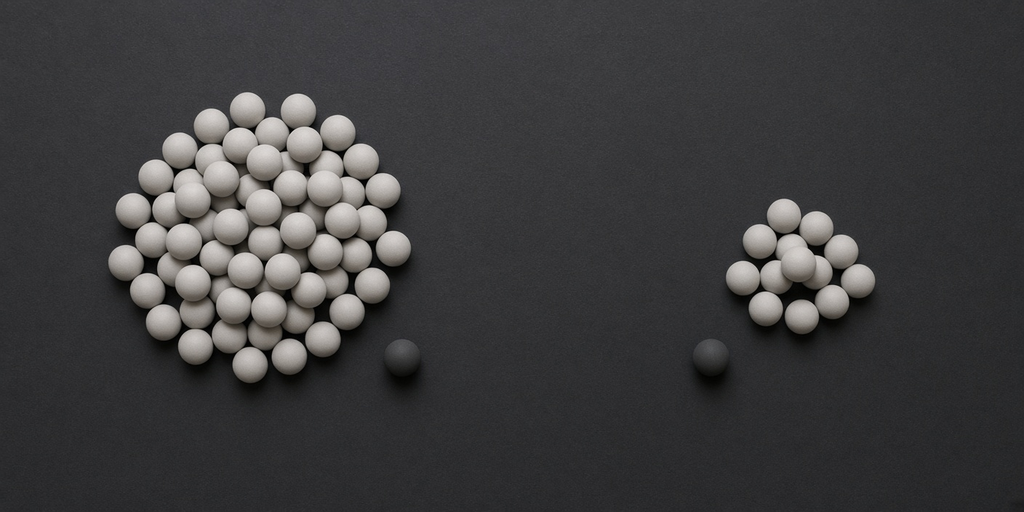
A ratio asks a question about the relationship between two quantities, and the same amount of 7-OH can sit on either side of the line depending on what it is sitting next to. In a product carrying a large amount of mitragynine, a given quantity of 7-OH is a small fraction of it. In a weak product carrying very little mitragynine, the identical quantity is a large fraction. Nothing about the 7-OH changed. The denominator did.
So the exposure moves, and it moves in a direction that is not obvious. Under an absolute cap, the products at risk were the strong ones. Under a ratio, the products at risk are the weak ones, because a fixed quantity is a larger share of a smaller total.
There is a second consequence that bears on documentation rather than chemistry. Laboratories report a result below the limit of quantitation when they cannot measure lower, and that limit is itself a fixed quantity. Set against a large mitragynine figure it is a trivial fraction. Set against a small one it may be more than one per cent on its own, which means a certificate can report that a substance was not detected and still not demonstrate that the product clears the ratio. That is not a finding about any product. It is a property of dividing a fixed detection floor by a variable denominator.
North Dakota Wrote The Old Number Into Statute
This publication reported in September that North Dakota had adopted the federal threshold into state law while the federal order itself had not issued. The headline on that piece was the oddity of a state codifying a number the agency proposing it had not yet imposed.
That oddity has now sharpened. The number North Dakota adopted is the number the recommendation of October 9 moves away from. A state statute does not update itself when a federal proposal changes, and North Dakota's legislature is not in session continuously. On the reporting available, that leaves a state threshold expressed as an amount sitting alongside a federal proposal expressed as an amount and a ratio, and the two no longer ask the same question.
This publication takes no view on what North Dakota should do about it, and has not established whether anyone there has raised the point.
Pennsylvania Reached For A Ratio Four Days Earlier
On October 5 the Pennsylvania House of Representatives passed House Bill 2657 by 202 votes to none. As reported, it would permit natural leaf products sold by state-registered retailers to people twenty-one and over, and prohibit synthetic or adulterated kratom. Accounts of the threshold disagree. Several describe a limit of 0.5 per cent 7-OH measured as a share of alkaloid composition, which is the figure in the bill as introduced. One account of a later House amendment gives 0.05 per cent measured by dry weight instead, together with a twelve per cent retail tax and a delay of one hundred and eighty days on the synthetic ban. This publication could not reach the enacted bill text to settle which figure is operative.
Whichever figure governs, the denominator is not the federal one. A share of alkaloid composition is a ratio against the product's whole alkaloid profile. A proportion of dry weight is not a ratio at all but a concentration, the same shape as the federal proposal of July 6. The federal recommendation measures against the mitragynine specifically. Colorado, whose statute this publication reported in September, uses a third basis: two per cent of total alkaloid content.
Three denominators at least, and a federal concentration prong expressed in milligrams per gram besides. A figure computed against one of them does not carry across to another, and a company selling into several states is not working against a single line but against several, written by different bodies and measured against different bases.
What Has Not Happened
The order still has not issued. A recommendation from one department to another, carried by notices of intent, is a proposal with a comment period attached, and the thirty-day period opened by the new notices has to run before any order can follow. The controls placed on mitragynine pseudoindoxyl, MGM-15 and MGM-16 on August 26 are reported to remain in force throughout.
Several things that appear in the coverage are carried by a single source each and are recorded here as unconfirmed. One account gives October 14 as the publication date for the new notice, puts the earliest effective date at November 13, and cites a Federal Register document number. Another reports that the July notice is being withdrawn rather than left to stand. This publication could not corroborate either and is not relying on them.
It is also worth repeating a correction this publication has made before, because the October announcement will give it fresh life. The action of August 26 did not schedule 7-OH. It covered mitragynine pseudoindoxyl, MGM-15 and MGM-16. The 7-OH threshold is the thing that has been pending since July and is still pending now.
Sourcing, Plainly
Nothing in this article was retrieved. The Health and Human Services announcement would not resolve from this publication's working environment, and the Federal Register is among the domains refused to it, so neither the recommendation nor the notices of intent was read. The piece carries no quotation marks anywhere, because no document was opened.
The two thresholds above are reported consistently across separate accounts of the October 9 announcement, including the Department of Justice's own description of what the agency would issue, and the shape of the change is firm. The exact wording, the units and the treatment of the alone-or-combined construction should be taken from the notices themselves before anyone makes a commercial decision on them. The reading that a ratio below one hundred to one is the same as one per cent is this publication's arithmetic and is stated as such.
Sources
- Reporting on the Health and Human Services recommendation of October 9, 2026 and the Department of Justice statement on the notices of intent, as it appears in search results. The originating releases were not reachable from this publication's working environment and were not opened directly.
- Department of Health and Human Services — recommendation of thresholds for enhanced kratom products (October 9, 2026)
- The Well News — on the Department of Justice statement and the two notices of intent
- Court Cast — on the revised scheduling thresholds and the hundred-to-one ratio
- Ermer and Suter PLLC — report of October 9, 2026
- Federal Register — DEA notice of intent, 7-hydroxymitragynine above a specified threshold, Docket No. DEA-1570 (July 6, 2026)
- Pennsylvania Capital-Star — on House Bill 2657 passing the Pennsylvania House (October 5, 2026)
- The Kratom Council — "North Dakota Adopted The Federal Threshold The DEA Has Not Issued"
- The Kratom Council — "Colorado Did Not Need A New Legal Theory"
- The Kratom Council — "What The August 26 Scheduling Order Actually Covers, And What It Does Not"
- The Kratom Council — "DEA Schedules Three 7-OH Analogs As The 7-OH Order Waits"
Get new reporting by email
Federal and state kratom policy, enforcement actions and court decisions — sent when we publish, and nothing else.
The Kratom Council does not sell kratom. This list is used only to send our own articles — never product marketing, and it is never shared with or merged into any retailer’s mailing list. Unsubscribe any time.