
Industry
"He Always Called It Kratom": What Shops Are Selling When The Label Says 7-OH
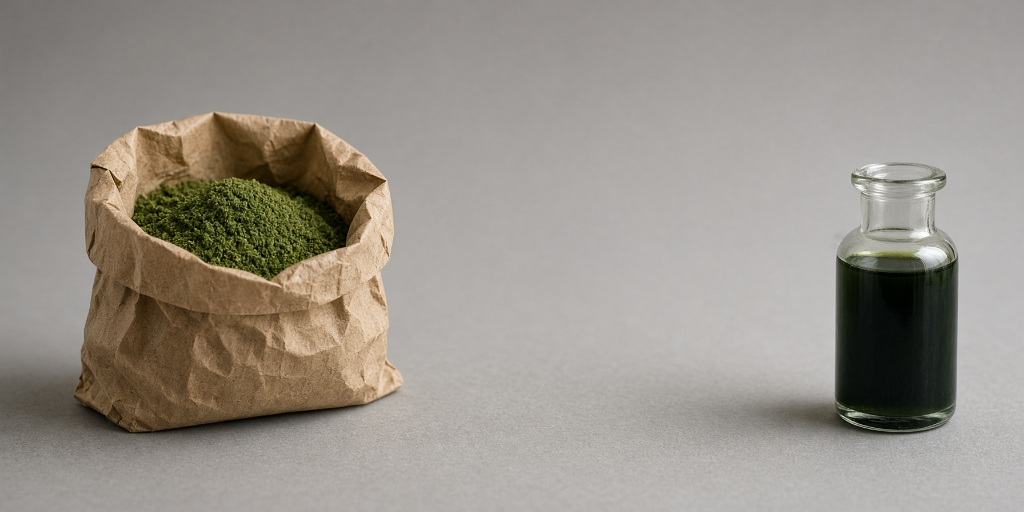
A Texas family told Newsweek this week that their son died after using a concentrated 7-hydroxymitragynine product he believed was kratom. The account, published August 13, turns on a single word — and on the gap between what a customer asks for at a counter and what a shop hands back.
Samuel Laws was born in Kingwood, Texas, in 1999. His parents, Paul and Anne Marie Laws, described a son who played bass, cooked, drew, and had taken a culinary diploma in 2024. They also told the magazine that he never used the term for what he was actually buying. "He always called it kratom," Paul Laws said. "He didn't know what 7-OH was. He didn't know it was addictive. He didn't know it could kill him."
What The Family Says Happened
The Laws family says it assembled the sequence only after their son's death. They found product in his bedside drawer in March, Anne Marie Laws told Newsweek, at a point when "his behavior had changed so much we didn't know what was going on." He told them he had stopped. He had not.
Their account of how the substitution happened is specific. "We believe he went to his usual vape store last year, where he was offered something stronger than kratom by the store owner, which was 7-OH," Anne Marie Laws said. "Sam never called it 7-OH; he always called it kratom." She put the family's reading of it plainly: "The people in the shop were selling him what he thought was kratom."
She later visited the shops herself. "One of them, which is the last store he bought from, I went in and asked if he had kratom. And he said, 'No, I have something much stronger. I have 7-OH.' I asked to see it, and I bought it." The product she bought, she said, was labeled at 98 percent alkaloids. Texas law caps 7-OH at 2 percent of a kratom product's total alkaloid content.
The family also described the frictionlessness of it — six dollars a unit, one store keeping it behind the counter, another displaying it openly. "It's just very easy for people to buy it," Paul Laws said.
What Testing Has Found In Products Labeled "Kratom Extract"
The chemistry underneath that story was examined in a peer-reviewed paper published this year in the Journal of AOAC International by Paula N. Brown, Michael Chan, Xiaohui Zhang and Thomas Brendler. The researchers ran commercial products through AOAC Official Method 2017.14 and compared the results against authentic kratom leaf.
Their findings describe two different things sharing a shelf. "All products were described on their label as containing 'kratom extracts,'" the paper states. Mitragynine — the leaf's most abundant alkaloid — measured between 2.0 and 6.0 mg per gram, which the authors call "substantially lower than typically found in kratom leaves or extracts." 7-hydroxymitragynine measured at 22 to 75 mg per gram, and ran 5 to 28 percent above what the labels themselves claimed.
The chromatographic profiles, the authors write, "were inconsistent with kratom leaf, having exceptional levels of 7-hydroxymitragynine, lacking the other major naturally occurring alkaloids, and exhibiting peaks not observed in leaf." Their conclusion is unambiguous about what that implies: the products "were verified to contain very high levels of 7-hydroxymitragynine, achievable only by synthetic means" and "are not kratom extracts, as labeled, but rather synthetic derivatives."
Scott Hemby, professor of basic pharmaceutical sciences at High Point University, gave Newsweek the same numeric contrast, putting natural leaf at "roughly 0.1 to 0.4 mg per gram of 7-OH" against extracts measured at "22 to 75 mg per gram," which he said indicates they were not produced by simply concentrating the plant.
What The Federal Government Has Said
The Food and Drug Administration has published a consumer page on these products stating that "7-OH products are novel potent opioid products that have not been proven safe or effective for any use and should be avoided," and that the agency "recommends that consumers avoid 7-OH products." It draws the same distinction the chemistry does: "While 7-OH occurs naturally in trace amounts in the plant kratom, the FDA's warning is for products containing 7-OH as an added ingredient or at enhanced levels, which can be dangerous."
On July 15, 2025, the FDA announced seven warning letters to firms marketing 7-OH products, describing goods "sold online and in smoke shops, gas stations, and corner stores" and noting that some were "unapproved new drugs with unproven claims such as relieving pain and managing anxiety." The letters went to Shaman Botanicals, My Smoke Wholesale, Relax Relief Rejuvenate Trading, Thang Botanicals, Royal Diamond Imports, Hydroxie, and 7Tabz Retail.
The pending federal action follows the same logic. As this publication has reported, the DEA's notice of intent under Docket No. DEA-1570 proposes a Schedule I threshold keyed to concentration — more than 0.050 percent on a dry weight basis, or more than 1.00 milligram per article for processed and synthetic material. The FDA's own summary of that action states the agencies' position on scope: the measures "are intended to target concentrated and synthetic 7-OH products and are not intended to apply to natural kratom leaf containing only naturally occurring trace levels of 7-OH." That order had not issued as of this publication.
Federal surveillance shows the volume rising. Researchers reporting in the CDC's Morbidity and Mortality Weekly Report on March 26 counted 14,449 kratom-related exposure reports to U.S. poison centers between 2015 and 2025, with a record 3,434 in 2025 — an increase of approximately 1,200 percent over the 258 reported in 2015. The authors write that the 2025 surge "coincides with the emergence of high-potency, semisynthetic formulations, including 7-hydroxymitragynine." They also caution that their data "do not include information about whether the kratom use involved traditional leaf products or semisynthetic or concentrated formulations," which is a limitation this publication examines separately.
The Confusion Is Now Its Own Documented Problem
Clinicians and researchers interviewed by Spectrum News on August 3 described the naming collapse as an obstacle in itself. "We can't just talk about kratom anymore," said Shravani Durbhakula, associate professor of anesthesiology at Vanderbilt University Medical Center. "We need to be talking about mitragynine versus 7-OH versus any other alkaloid that might be compounded."
Christopher McCurdy, professor of medicinal chemistry at the University of Florida, told the outlet that "this real sort of trash can designation for all of the products by clumping them together has created a great amount of confusion — not only in the medical establishment and in the consumer base, but in the toxicological and policy-making space." Carin King Malley, an emergency physician and medical toxicologist at Maine Medical Center, put the bedside version of it this way: "We don't know what's in each product."
What This Does Not Settle
Two things are worth stating directly, because the distinction at the center of this story is narrower than it can appear.
The first is that a threshold is a legal line, not a safety finding. The federal proposal separates material by concentration; it does not certify anything below the line. The FDA's own consumer page carries a closing note that "the FDA has also warned consumers not to use kratom because of the risk of serious adverse events, including liver toxicity, seizures and substance use disorder." Coverage that presents the 7-OH action as a clearance for leaf is misreading it.
The second is that this publication takes no position on the pharmacology. The comparative potency figures, the receptor mechanism, the clinical presentations and the addiction findings described above are the statements of the named researchers, physicians and agencies who made them, reported as such. The Kratom Council has not evaluated them, and nothing here is medical advice.
What is documented, and not in dispute among the sources above, is narrower and still significant: products have been sold at retail under a label that testing says does not describe them. The Laws family's account is of a customer who asked for one thing across at least four shops and was handed another, at six dollars a unit, without ever learning the name of what he had.
Sources:
- Newsweek — Amanda Castro, "Family Pushes for Permanent Ban After Son's Death From Retail Opioid" (August 13, 2026)
- Brown PN, Chan M, Zhang X, Brendler T — "Elevated 7-Hydroxymitragynine Levels Found in Products Misbranded as Kratom," Journal of AOAC International, vol. 109 (2026), PMID 41065466
- U.S. Food and Drug Administration — Consumer Update, "Products Containing 7-OH Can Cause Serious Harm"
- U.S. Food and Drug Administration — "FDA Issues Warning Letters to Firms Marketing Products Containing 7-Hydroxymitragynine" (July 15, 2025)
- U.S. Food and Drug Administration — "Hiding in Plain Sight: 7-OH Products," update on 7-OH and synthetic kratom-related compounds (current as of July 13, 2026)
- Federal Register — "Schedules of Controlled Substance: Temporary Placement of 7-Hydroxymitragynine Above a Specified Threshold in Schedule I," DEA notice of intent, Docket No. DEA-1570 (July 6, 2026)
- Towers EB, Thomas YT, Holstege CP, Farah R — "Increases in Kratom-Related Reports to Poison Centers — National Poison Data System, United States, 2015–2025," MMWR Morb Mortal Wkly Rep 2026;75(11):139–145 (March 26, 2026)
- Spectrum News — Camille DeLongis and Sarah Douglas, "Experts warn of confusion, risk as DEA moves against 7-OH" (August 3, 2026)
- FOX 7 Austin — "Texas sues Smokey's Paradise over illegal kratom potency limits" (February 9, 2026)
Get new reporting by email
Federal and state kratom policy, enforcement actions and court decisions — sent when we publish, and nothing else.
The Kratom Council does not sell kratom. This list is used only to send our own articles — never product marketing, and it is never shared with or merged into any retailer’s mailing list. Unsubscribe any time.